



When choosing a drone for education, the best option is not necessarily the fastest, most powerful, or most expensive drone. An educational drone should be designed to help students learn, experiment, code, build, and solve problems.
For schools, STEM programs, camps, and training centers, the right coding education drone should combine ease of use, safety, durability, programming capabilities, and a curriculum that supports meaningful learning.
What Makes a Good Educational Drone?
A good drone for education should offer more than basic flight.
1. Easy to Learn
Students should be able to understand the basic controls quickly. A drone that is difficult to operate can turn a STEM lesson into a simple flying exercise.
Beginner-friendly controls allow students to focus on concepts such as flight, sensors, programming, and problem-solving.
2. Supports Coding and Programming
One of the biggest differences between a consumer drone and an educational drone is programmability.
A STEM drone should allow students to create commands, automate flight paths, experiment with logic, and see the results of their code in the real world.
This makes drones a powerful tool for teaching coding, computational thinking, and engineering.
3. Hands-On Learning
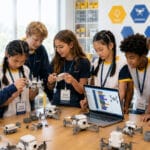
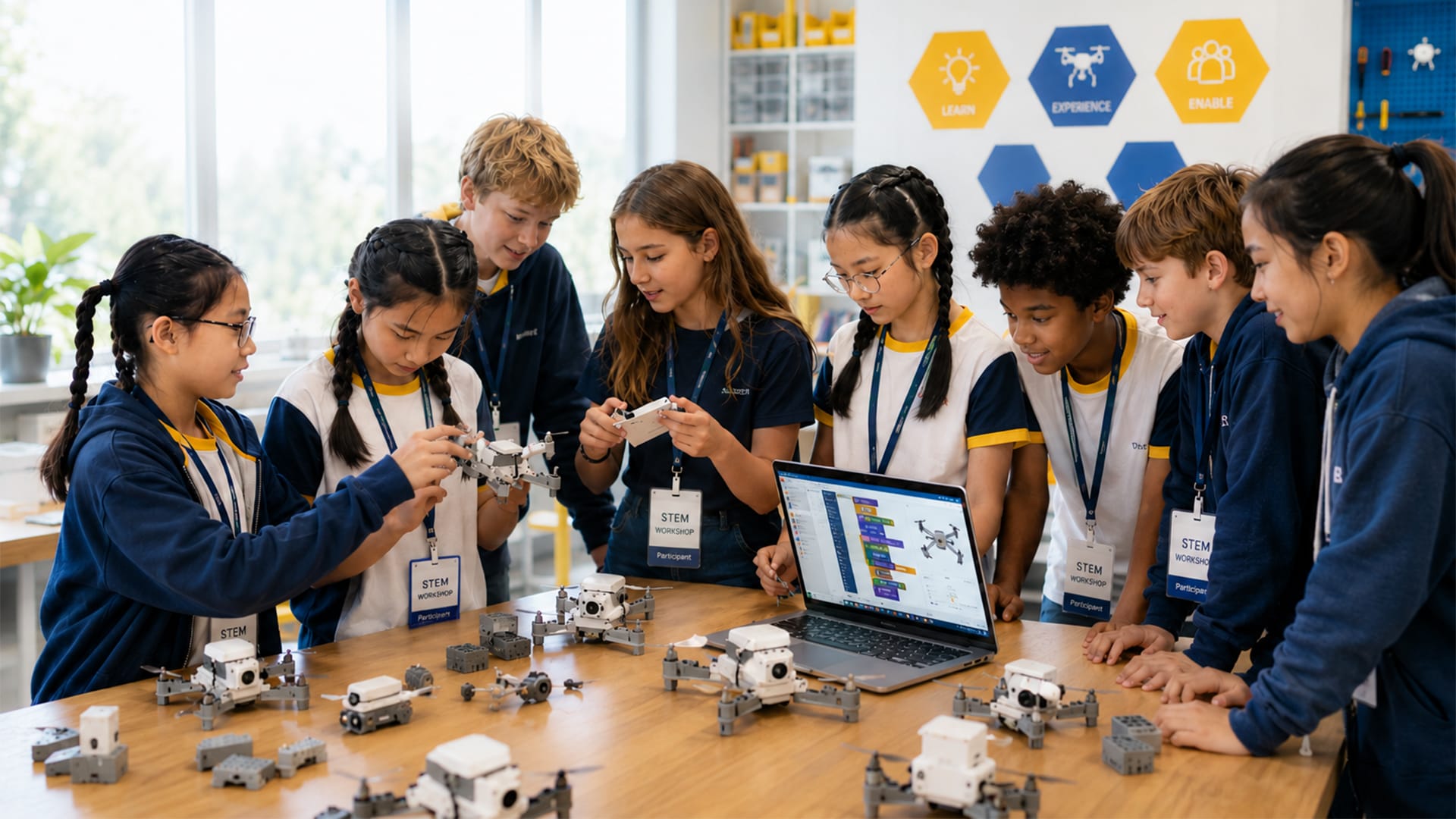
The best educational drones encourage students to build and experiment.
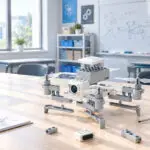
Modular designs allow students to assemble components, modify their drones, test different configurations, and learn from mistakes.
This hands-on approach connects classroom concepts with real-world engineering.
4. Safe and Durable
Educational environments require equipment that can handle frequent use.
A suitable classroom drone should be lightweight, easy to operate indoors, and durable enough for repeated student activities.
Safety is particularly important when drones are used by younger learners.
5. Comes With Curriculum Support
Hardware alone does not create an effective drone education program.
Teachers also need structured lessons, teaching materials, project ideas, and training.
A complete educational drone solution should therefore combine hardware + software + curriculum + teacher support.
What Is the Best Drone for Education?
For schools and STEM education programs, the best drone is one that turns flight into a learning experience.
An educational drone should help students move from:
Build → Code → Fly → Experiment → Solve
rather than simply:
Fly → Land
This is why modular and programmable drones are increasingly valuable for STEM education.
Why Educational Drones Are Different From Consumer Drones
Consumer drones are primarily designed for entertainment, photography, or recreational flying.
Educational drones have a different purpose.
They are designed to help students understand concepts such as:
- Coding
- Robotics
- Engineering
- Sensors
- Aerodynamics
- Computational thinking
- Problem-solving
- Systems thinking
For example, students can program a drone to follow a specific flight path, build a custom drone configuration, or create a challenge that requires both coding and engineering.
The drone becomes a learning platform, rather than simply a flying device.
Choosing the Right Drone for Your Program
Before purchasing an educational drone, schools and educators should consider five questions:
- What age group will use the drone?
- Does it support coding and programming?
- Can students build or modify the drone?
- Is it suitable for indoor classroom use?
- Does the manufacturer provide curriculum and teacher support?
If the answer to these questions is yes, the drone can become much more valuable as an educational tool.
Final Thoughts
The best drone for education is not necessarily the drone with the highest specifications.
It is the drone that makes students curious enough to ask questions, capable enough to experiment, and confident enough to build something of their own.
For STEM education, a programmable, modular, and classroom-friendly drone can provide a powerful way to connect coding, engineering, and hands-on learning.
That is the real value of an educational drone: students do not just learn how to fly—they learn how technology works.